


The disastrous Battle of Culloden has long been regarded as a turning point in Scottish history.
It was April 26th, 1746, on Drumossie Moor, later called Culloden, not far from Inverness, that Bonnie Prince Charlie’s Jacobite supporters were soundly defeated by British government forces led by the Duke of Cumberland. In the shadow of this monumental loss, the process of disassembling not only Scottish clan structure, but the Highland way of life began.
The bloody battle is sometimes reduced to British (Hanoverian) versus Scottish (Jacobite) armies, but the reality was far more complex. Jacobitism – those who believed Bonnie Prince Charles (King James Stuart’s grandson) was the rightful heir to the throne and King George II an imposter – was a decades-long cause that attracted followers from Scotland, England, Ireland, and even France. Likewise, the Hanoverian side was composed of Scottish clans, British, Irish and German units. It was also the final conflict in a series of skirmishes that had lasted years.
Post-Culloden, the lairds who fought against the government had their lands and castles forfeited. Many were executed or sent away and their men conscripted into the British army. Highlanders were forbidden to wear traditional clothing e.g. kilts and tartan. Weapons such as dirks, muskets, claymores and broadswords were outlawed. Even the bagpipes were prohibited. Those who defied the laws risked arrest, heavy fines, imprisonment and exile. Nevertheless, they were still flouted.
Red coats were stationed in garrisons throughout the Highlands to enforce the new rules, and a network of roads were built to make it easier for government soldiers to infiltrate the impenetrable landscape. Jacobite lands were given to wealthy Brits (or bought by them) and Hanoverian-loyalist lairds.
In the years following Culloden, famine struck the land. Worse, the villages where folk had lived, worked and died for generations were sometimes cleared so the more profitable sheep could be installed on the pastures, moorlands and so on. Thousands were displaced and sent to overcrowded cities or forced to immigrate. It was a heartbreaking time.
Despite efforts to stamp out resistance, the rebellious spirit of the Scots was far from extinguished. This is especially evident when considering whisky. After Culloden, not only were a series of stringent laws passed regarding whisky production, but heavy taxes were levied. Extra tax collectors or excise officers (also called ‘gaugers’ because they gauged the amount of spirit) were hired to travel deep into the Highlands in an effort to patrol and police whisky-making and claim revenue for the King’s purse. Smuggling (making, distributing and selling illicit whisky) and thus avoiding paying excise became not only an essential way of life for many Highlanders (and in other parts of Scotland) but a means of survival. Whisky came to signify defiance, a form of rebellion, that challenged English authority.
The Battle of Culloden and whisky are, rightly and wrongly, imbued with romance, one that’s at once, violent, tragic and complex. They also represent, in diverse ways, the defiant spirit of the Scots.
ABOUT THE AUTHOR: Karen Brooks
Karen Brooks is the author of sixteen books – historical fiction, historical fantasy, YA fantasy, and one non-fiction. She was an academic for over 20 years, a newspaper columnist and social commentator. She has a Ph.D. in English/Cultural Studies and has published internationally on all things popular culture, education and social psychology. An award-winning teacher, she’s taught throughout Australia and in The Netherlands and keynoted at many education conferences. Nowadays, she finds greatest contentment studying history and writing, and helping her husband in his Brewstillery, Captain Bligh’s.
She shares a beautiful stone house in Hobart, Tasmania, built in 1868, with her husband, adorable dogs and cats, and shelves brimming with books.
Love Scottish History? Don’t miss Karen’s new book The Whisky Widow
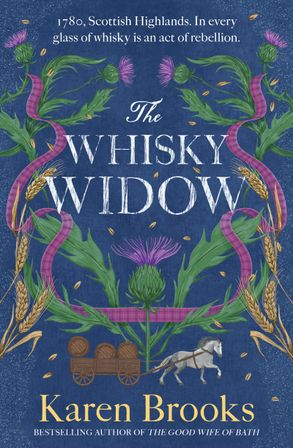
From the bestselling award-winning author of The Good Wife of Bath comes this rollicking historical adventure that celebrates the art of whisky distilling, the defiant spirit of the Scottish Highlanders and a woman’s fearless quest.