


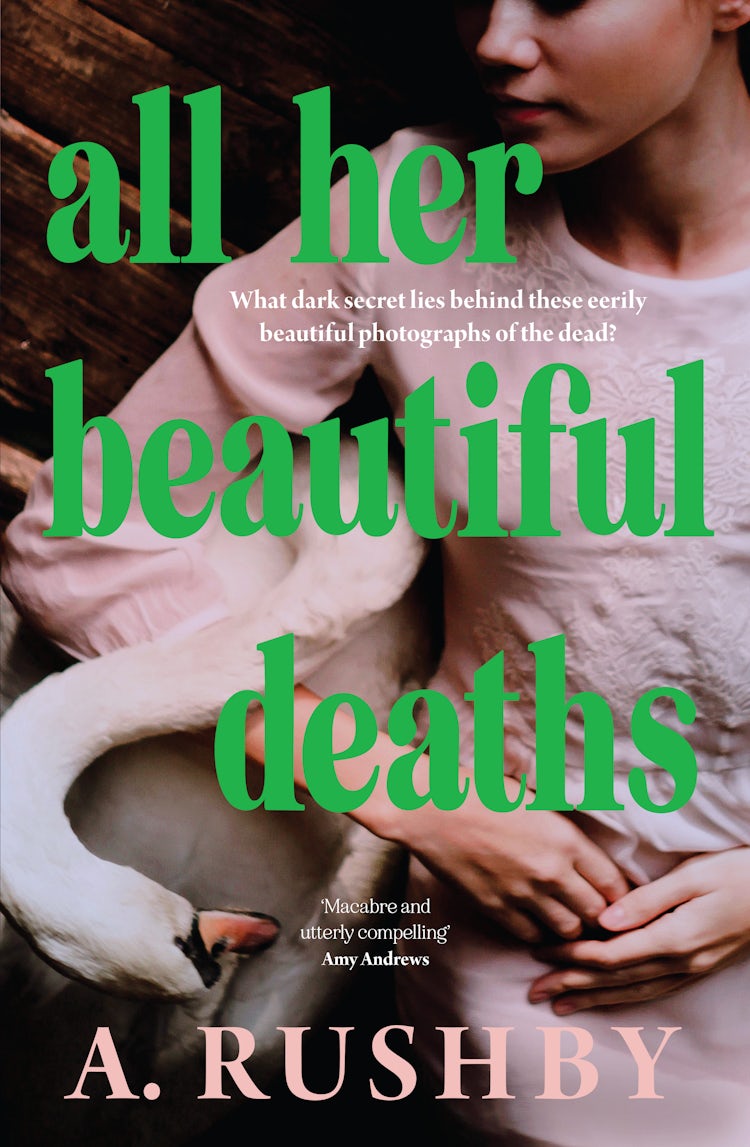
More than a century apart the lives of two artists intersect through a series of mysterious, eerily beautiful photographs of the dead.
London, 1865. Desperate for work, Minnie takes employment as a maid for the wealthy young Culpepper twins. The siblings lead a strange and unconventional life: Edmund operates a laboratory from the house while Edith experiments with morbid photography. Drawn in by a dangerous attraction to one of the twins, and with a sick sister of her own to provide for, by the time Minnie makes a disturbing discovery it's too late - she must stay and unravel the mysteries of Culpepper House before she becomes a victim of one of Edith's photographs herself.
London, present day. Grieving artist Hadley is consumed by an album of Victorian death photography, including the exquisite image of a deceased young girl with a swan. When this photograph is involved in an art world scandal, Hadley is given the opportunity to create an installation surrounding the image. But the enigmatic Kit Culpepper, of the Culpepper Trust, has other plans. He offers Hadley an eye-watering sum of money to sell him the album and never speak of its contents again. As Hadley digs deeper into the album's truths, she begins to suspect Kit Culpepper is guarding a deathly secret ... and she's not entirely sure how far he'll go to keep it.
Minnie
London, September 1865
THE MOMENT MINNIE PEERED through the ornate wrought-iron gates, she knew she had made a mistake in coming to Culpepper House. Everything about the residence was unwelcoming. Everything warned her to turn back. The garden – if it could be called that, for a garden suggested a manicured space – had been left to run wild and unchecked. A veritable forest ran up either side of the short drive, some of the larger trees’ branches meeting menacingly overhead, casting pools of deep shadow on a day that was already grey and gloomy.
Her mood, sombre on the long walk to Highgate, had taken an even darker turn as she closed in on her destination, for Culpepper House sat directly above Highgate Cemetery. What a place to live! Surely the upper windows of the towering, turreted red-brick building with its intricate carvings and cornices would look out over a sea of monuments and tombs. The only neighbours in sight would be the dead, the only structures the cemetery’s unlikely Egyptian architecture. On realising the outlook, Minnie considered turning about and trying her luck by knocking on any other door for work. But then a funeral procession had wound its way down the road, and out of respect she had been forced to stay put. She was now standing in silence next to a man who had been similarly caught out, the two of them dipping their heads as a glass carriage passed by, complete with four beautiful black Belgian horses, ostrich feathers bobbing atop their heads.
‘In you go then, lass,’ the man standing beside her told her once the procession had moved along. She had asked him for directions – as she had asked several people on the hour-long walk from Muswell Hill – and he had kindly walked her the rest of the short distance to the house. ‘Gate won’t be locked, I think.’ As if to prove his point, he stepped over, thrust a hand around the back of the gate itself, fiddled with the latch and gave it a shove. The gate creaked ominously but opened easily enough. ‘Ask for Mrs Wilson. Runs the show there for the most part, she does. You’ll find the kitchen at the rear. That’s where I make my own deliveries.’
Minnie nodded, glancing down at the note she clutched in her hand, on which Mrs Wilson’s name was scrawled. ‘Thank you,’ she said, remembering her manners. And so as not to seem rude, she slipped inside the gate, opening it a little further to let her carpet bag in with her also.
The man took himself off then, whistling jauntily as he continued on his way. Minnie waited a moment, her ears trained on his departing footsteps, as if she might then dare to dart out the gates once more and run back to whence she had come.
Oh, to have such an option. To have some safe haven she might return to, removing her hat and falling into a comfortable chair to partake of a cup of tea after her long journey on foot. ‘Goodness,’ she might exclaim to the loved ones awaiting her return. ‘What a day! What a house!’
But she had no such situation to return to. No safe haven. No comfortable chair. And while she had one loved one – her cherished twin sister – Molly barely had the breath to stand upright by the end of the working day, let alone run about making Minnie cups of tea.
And so, her heart sinking, Minnie turned once more towards Culpepper House and ventured forth into the deep, dark forest, feeling for all the world like a character in a fairy tale, though she well knew that no fine adventure or happy ending lay in store for her. Only a life of scrubbing pans and lighting fires and emptying chamber pots, most likely.
The bag thumped painfully upon her leg as she walked, and the wind began to whip up angrily around her. She paused to look up at the house when it came into full view, for it felt as if someone was watching her. But she could see no one. Only the house’s windowed eyes staring back at her. Continuing on her way, she finally located a door around the back of the house that seemed likely to be the kitchen, for a small greenhouse and a kitchen garden lay just beyond it. She paused to put her bag down just out of sight. It seemed presumptuous to arrive at the house begging for a position with all her worldly possessions in tow, but the woman who had given her Mrs Wilson’s name had assured her she would be taken on. That they would be glad to have someone who was willing to live in.
‘They’re odd,’ her sister’s neighbour, Mrs Davies, had said bluntly, for she was a blunt sort of woman. ‘Pay well, though. Far better’n most, that’s for sure. Mr Culpepper is a generous sort.’
Mrs Davies had told Minnie she used to go in to help with the laundry at Culpepper House, until she had moved further away with her family. It was Mrs Davies who had pressed the note into Minnie’s hand. ‘You go and see Mrs Wilson there at the house. Tell her I sent you. I’ve sent a few girls her way in my time. She’s always been pleased with my recommendations.’ She sniffed. ‘Always good enough to send me something to say thank you, too.’
But Minnie was still caught up on the word Mrs Davies had led with. ‘Can I ask… what do you mean by “odd”?’ Odd could mean any number of things. A family member kept under lock and key. A master of the house who might press himself up against you. Or worse. She did not fancy ending up fodder for some garish tale in The Illustrated London News or living out the sensational story of a heroine in a penny dreadful.
Mrs Davies tutted. ‘Nothing untoward. Bit of misfortune, really. Brain fever. One of those medical sorts who are always coming in and out of the house brought it back from a trip to some far-off land or another. Took Mr Culpepper off. His wife. And little Miss Violet. Just on five she was. A great loss, as the family all doted on her terribly. Almost took the older daughter, too. That’s Miss Edith. She got better, though the brain fever left plenty wrong with her. Lost her hearing in one ear. Can’t speak no more. Not properly. Has to write everything down in a little notebook she carries about her neck. You can read?’
Minnie nodded.
‘Good. For you’ll need to if you’re to understand her. The son caught the brain fever too – Mr Edmund Culpepper. But he was only in bed a few days so far as I know. So at least there was someone to take over the business. No rhyme nor reason to these things, is there?’
A shake of her head this time. Minnie knew for a fact that there was no rhyme nor reason to life. She had tended so carefully for her mother in her final days, only to be booted onto the street by her father’s new wife less than six months later. So much for family. Her father had sent her off to her sister Molly’s cottage in Muswell Hill in the hope that she might find work nearby as a nurse. It had been only days before Minnie knew her time at her sister’s would be short. They were identical twins but could not have been more different. Molly had always been a quiet soul. A thinker. Meanwhile, Minnie was brash and outspoken. Impulsive. And often in trouble. Two sides of the one coin. Together, however, they made a whole.
In their younger years, the girls had met with different reactions to their identical features. Some people were simply curious. Others shunned them, as if they might belong in a circus. Older folk would sometimes cross the street, muttering about witchcraft. But they were not so similar now, people often believing them to simply be sisters, rather than identical twins. Molly had contracted rheumatic fever shortly after marriage and her body had suffered terribly for it. She looked far older now than her twenty-three years. Tired and constantly breathless, with swollen ankles and blue fingers. Always cold. Minnie was forever wrapping her twin in blankets. Sitting her by the fire. Nothing could warm her, and Minnie longed to take her sister to a place where the hot sun would heat up her very bones. They had a cousin who had gone to Australia and who had written to them, urging them to come also. That was Minnie’s dream. To take her sister to Australia. An impossible dream, but a dream, nonetheless.
Whenever Minnie spoke of this dream, Molly would nod and smile. It was not a dream her sister dared indulge in. She was a married woman, and a woman married to a man who would not even fetch a doctor for her, let alone take her to Australia for her health. Molly’s husband had always had a liking for drink, even at the very start. But as Molly had lost baby after baby and become weaker and weaker, he had turned upon her. He had hoped to have sons who might help him with his carpentry work and seemed to blame Molly for not being able to provide them. Minnie’s recent presence only seemed to irritate him further. Two evenings ago, they had fought and he had caught at Minnie’s arm.
She looked down now at the three bruises on her forearm where his fingers had dug into her. ‘Your sister can’t, and you won’t. Unnatural you are,’ he’d hissed under his breath. And Minnie had known he was not speaking of her being a twin.
No, she could not remain under the same roof as her sister’s husband any longer. She needed to find a position, and she needed to find one fast.
‘Don’t you fret.’ Mrs Davies had obviously seen Minnie’s reservations. ‘The Culpeppers are decent enough people. No harm will come to you there. Like I said, they’re just odd. They don’t entertain. Rarely have visitors, except when it comes to the business side of things, and then it’s men of science coming and going at all times of the day and night. It’s all about the pills and potions with that lot. You’ve heard of Culpepper’s Cure, of course.’
Minnie had pondered the woman’s question. She had a vague memory of a cobalt blue bottle with a long neck and also of an advertisement in which one woman surreptitiously passed said bottle to another woman under a dining room table with a knowing look. The advertisement suggested the contents might solve all the woman’s feminine problems in one fell swoop – from a nervous disposition to bad smells, pallor and even ‘feebleness of mind’, which seemed quite a stretch for one simple concoction. ‘I believe I have heard of it,’ she replied.
‘Course you have,’ Mrs Davies said. ‘Everyone has. That’s how the Culpeppers came to be so rich.’
The door flew open, returning Minnie to the present. Before her stood a sturdy, sharp-faced woman who eyed her shrewdly.
‘Mrs W-Wilson?’ Minnie stammered. ‘Mrs Davies sent me. She said you might have a position for me.’ She reminded herself to appear meek and mild. She needed this position. The money. If not to travel to Australia, at least to find a more skilled doctor than the ancient one who had attended to her sister lately. And, of course, she needed a place to live.
One of Mrs Wilson’s eyebrows raised. ‘Mrs Davies, eh? And you are?’
‘Minnie. Minnie Price.’
‘Well then, Minnie Price, what are you good for?’
‘I nursed my mother. I can keep a house. Cook a little.’
‘Cooking’s my domain,’ Mrs Wilson said, folding her arms. ‘But I could always do with a hand.’ She paused a moment to take Minnie in in her entirety. ‘We all pitch in around here. Have to. The Culpeppers don’t like a lot of staff about. They’re private types. There’s no airs and graces and French lady’s maids and so on. None of this “you do this and I do that”. We all do our bit and we get by. Understand?’
Minnie nodded, as if she was party to the inner workings of fine houses. Which she was not.
Mrs Wilson’s eyes narrowed. ‘You’re not in any trouble, are you?’
‘No, Mrs Wilson. It’s only my father remarried and –’
Mrs Wilson held up a hand. ‘I don’t need to know the ins and the outs of it. I just don’t want any trouble. And there are to be no followers.’
Minnie nodded again. There would be no followers.
Mrs Wilson’s gaze moved down to the carpet bag that was poorly hidden near not far from Minnie’s feet. ‘Brought your things, I see. Bit sure of yourself. Must mean you’re a good worker that you knew we’d take you on.’
‘I… Mrs Davies said to…’
But Mrs Wilson only chuckled. She was already opening the door. ‘Come on then. I know Mrs Davies wouldn’t send me a girl who wasn’t prepared to work. And she will have told you the pay is good.’ She named a sum that was almost twice what Minnie had expected to receive, and Minnie hesitated. There had to be some catch. The word ‘odd’ bubbled up to the surface of her mind once more and her step faltered. ‘Don’t stop there in the doorway, my girl…’ Mrs Wilson took her bag from her, ushered her through a short entryway into the kitchen proper and dumped it unceremoniously under a scrubbed wooden table. Minnie looked about herself. It was a fine kitchen. Large and well kept, full of neatly stacked bowls and gleaming copper pans.
Mrs Wilson, she could see, ran a tight ship.
‘Now…’ Mrs Wilson said, pausing for a moment, as if righting herself after Minnie’s interruption. ‘How should we get started? What can I tell you? Best just to keep out the way of the master of the house, which shouldn’t be hard as he’s usually in the laboratory or his study. That’s young Mr Edmund Culpepper now that his father’s gone. I expect Mrs Davies told you what happened here. With the brain fever.’
‘She did mention it,’ Minnie replied.
Mrs Wilson took Minnie in again, as if she hadn’t truly noticed her before. ‘Hmm. I’ll bet Miss Edith takes a shine to you. Always coercing any fine-looking beast that crosses the doorstep to pose, she is. Though I must admit her portraits can be a little strange. She took one of me once right here – didn’t even want me to stand still – and for all the world she made me look like some sort of kitchen sprite! Funny old photograph, but I must admit it’s grown on me. There’s something that’s just right about it. You looking as you do, she’ll want to take your photograph as well, I’ll wager. Ever had your photograph taken before?’
Minnie shook her head, though this was a lie. A man had once coerced her parents into letting him take photographs of her and her sister. He had paid her parents handsomely. Too handsomely. So much so that, as an adult, Minnie worried at how those photographs had been used. Whose hands they had fallen into. She still recalled the gruelling process and the metal posing stand that had pinched at her skin horribly. And she could not forget the loitering touch of the man’s hands as he had positioned her body. How he had forced her and her sister to take one photograph dressed in thin cotton nightgowns and insisted on smoothing the folds of the fabric over and over on their bodies. Her stomach turned at the thought of that day.
‘Yes, Miss Edith couldn’t be more taken with her photography. Messes about with glass plates and all sorts of chemicals and washing of this and rinsing of that. It’s beyond me to understand. Right vinegary she gets when it doesn’t pan out, which it often doesn’t. Need to stay out of her way then. As much as she doesn’t want assistance, she does need help setting things up. Staging her pretty scenes. She still weakens quickly, you know.’
Minnie didn’t know, but she nodded as if she did. She had mentioned her nursing abilities after all.
Mrs Wilson turned to look at the mess that had been made in the kitchen. Piles of vegetables were half chopped, several chickens were dressed, awaiting roasting, and a mound of freshly washed potatoes required peeling. ‘Good timing you have, I suppose, for we have some guests at the moment.’ She paused here and tutted. ‘There’s been a… a death.’
Minnie drew back. ‘Brain fever?’
‘Goodness, no. That was close to two years ago now. No. Not brain fever. A young lady they brought to the house in the hope that Mr Edmund and his medical friends might be able to save her with the cures they’re always working so hard on. But it was not to be. She was too far gone, the poor lamb. Such a shame, for I remember her from when she was just a wee thing. A dear girl, and her mother was a cherished friend of the late Mrs Culpepper’s.’
‘I’m sorry to hear it,’ Minnie replied. As she spoke, a keening wail began, drifting into the room from upstairs, slicing through her words.
Mrs Wilson looked up at the ceiling with a sigh. ‘That’s the mother again. She’s been going at it all morning, poor thing. A houseful of doctors and medical types can’t calm her. And rightly so, for she was their only daughter.’
The keening became louder. Mrs Wilson bit her lip as if waiting for it to end.
It did not end.
‘I’d best go up and see if they need my help. For I know Miss Edith and Mr Culpepper are busy.’ She wiped her hands on her apron, then reached around her back and untied it, placing it on the table beside her.
‘I can…’ Minnie looked around herself, unsure of where to start.
But Mrs Wilson was already departing the room.
‘The potatoes maybe,’ Minnie continued. She would be meek and mild and make herself useful, and Mrs Wilson would be pleased with her on her return and ever so glad she had given her a position. She located a fresh apron and tied it about herself neatly. She picked about the kitchen until she found a paring knife and a bowl, and then she began to deftly peel the potatoes. She had finished a small pile when she heard a heavy thump emanate from outside the kitchen. Fearing someone would enter and accuse her of being a thief (though why a thief would enter a house and begin peeling potatoes she wasn’t quite sure), she put down the paring knife and went to make her way to the door to see who she could see. As she went, she caught her dress on the handle of a drawer and sighed. Now it would have to be mended. She unsnagged it and continued on her way.
She was met with a view of a short hallway. On one side there seemed to be a scullery with its large sinks and plate racks. It led back through to the kitchen itself and also outside to the kitchen garden. On the other was a small room with a desk inside it stacked with ledgers that looked like the domain of a housekeeper, or butler. This was all the servants’ domain. But ahead was an open doorway, and visible beyond it was a fine, sweeping set of stairs that led upwards, which is where Minnie guessed Mrs Wilson had run off to, for that is where it had sounded as if the wailing was coming from.
Then, the sound of a quick, light step. A dark-haired young lady in a black gown rushed past, her movements too bright – too quick and full of life – for this dark and dreary house. She carried something in both hands. A large wooden box. Whatever was in it seemed delicate by the careful way she held it. Precious.
She was a whirlwind of movement that was gone in but a moment, leaving a mesmerised Minnie somehow feeling winded herself. For there was a fierce intensity – a ferocious energy – about the young woman that had been wonderfully breathtaking.
Minnie heard a door creak, as if the girl had entered a room. She waited but did not hear the door close.
Curious, Minnie forgot all about being meek and mild and began to creep down the hallway. What was the lady doing in such a hurry?
When Minnie reached the stairs, she could hear voices winding their way down from above. It sounded as if people were tending to the mother of the young lady who had passed away. Thankfully, the wailing had ceased now, and Minnie hoped the woman had found some little relief in whatever form it might come in.
Another clatter of hurried footsteps caught her attention, bringing her gaze back down to a room a short way up the hallway, where the door now stood ajar.
Two steps and Minnie was there. She peeped inside. The room was brighter than the dark hall – the curtains drawn wide and oil lamps providing illumination. And there was the young lady who had rushed past. She moved about with purpose with the wooden box. Minnie took in her mourning dress of black crape, which was shockingly ruined. It had been allowed to get wet and had large, rust-coloured stains upon it. She took the wooden box over to a table, opened it and then began to lift out what seemed to be a set of wooden boxes from the interior.
It was then that Minnie knew that this was Miss Edith and what was in each of the interior boxes was a glass plate. She was taking a photograph.
Minnie craned her neck as Edith then took one of these boxes across the room, stood on a pile of books and slid the box into a camera that rested upon a tripod. She then moved around, put her head under a black cloth and began to adjust the instrument. Minnie took in the flash of silver at Edith’s throat as she quickly adjusted this and straightened that. A little notebook and pencil dangled from a chain, just as Mrs Davies had said.
Minnie was entranced. A woman who took photographs. Who ran about with glass plates and cared not for ruining black crape (admittedly a hideous fabric). The fact that she had a brother who allowed her to do so was interesting – a brother who took in friends of the family and attempted to cure them with the help of his medical friends.
Yes. The Culpeppers were definitely odd. But it was an interesting sort of odd. Not dangerous, or bad, but unusual. Eccentric. Perhaps this place would not be so bad after all?
Minnie wiped her hands on her apron. She should enter and offer to help, for Miss Edith seemed flustered, her colour heightened and her cheeks flushed. Mrs Wilson had mentioned she tired easily. The potatoes could wait. Having made her decision, Minnie went to move to enter the room. But as she did so, Edith alighted from the pile of books and stepped away from the camera, as if moving over to scrutinise her subject.
Minnie craned her neck even further, hoping to catch a glimpse of what it was that Edith would be photographing today. ‘Staging her pretty scenes,’ Mrs Wilson had said. Minnie wondered if it would be a beautiful arrangement of flowers, or something adorable such as sleeping kittens.
Minnie moved forward, caught a different view and then pulled up sharply. Edith was not alone in the room, as she had thought. She saw then the two young men who were also in attendance. They stood deep in discussion, looking down at something and holding an object between them. As she watched, one of them touched the other on the arm in an intimate way that told Minnie instantly that they were more than just friends.
However, it was not this that shocked Minnie to her very core, but the object one of them held in his hand.
A small dome of a thing, she knew exactly what it was – a mask. A mask that ether or chloroform might be dripped upon and then the mask held over someone’s face until they found themselves unconscious.
She knew that mask well, for she had seen one held down over her mother’s face once as she lay on the kitchen table in their own house. The doctor had let the medicine drip, drip, drip upon the mask, and her mother had fought the sickly-sweet smell of ether until she could fight it no longer. Minnie had not stayed to watch the doctor cut the tumour from her mother’s breast.
Slowly, and as quietly as possible, Minnie inched to her left so she might see more of the room.
And that was when she finally saw what it was that Miss Edith Culpepper’s photograph would capture when she removed the lens cap.
A large expanse of black velvet.
A large expanse of black velvet with a dead girl and a dead swan upon it.
'Deliciously macabre and deeply felt, All Her Beautiful Deaths is an enthralling tale of grief, art, love, and death.' - Christine Wells, author of The Lost Perfumes of Paris
'A macabre family mystery that weaves across the generations, All Her Beautiful Deaths is also a twist-filled love story that gets under your skin. Intrigue builds as the story pulls in the dark side of Victorian photography and the politics of today's art world to reach an unexpectedly life-affirming denouement. An addictive read.' - Carolyn Kirby, author of The Conviction of Cora Burns
'Delicately crafted and darkly immersive, All Her Beautiful Deaths serves up sumptuously gothic settings, deliciously macabre goings-on and the alluring thread of a singular uncanny compulsion across time. It's the kind of story you fall into, find yourself ensnared, and are glad of it.' - Ally Blake, award-winning Australian author
'Twists aplenty and a fascinating insight into the Victorian practice of death photography ... utterly engaging read' - Jenni Keer, author of The Ravenswood Witch