


Australian author Karen Brooks dropped by the blog to tell us about all the research she did for her new novel The Extraordinary Florence Stoker.
*****
An historical novel like The Extraordinary Florence Stoker, where 95% of the characters existed, requires extensive research balanced with creative flair. While it’s important every single figure is represented not just accurately, but respectfully and with sensitivity, it’s also a work of fiction, albeit one that draws heavily on facts, therefore the story is the queen.
Though I’ve adopted this praxis for my last seven historical novels and determined to bring to the forefront another woman maligned and forgotten by history, tackling a sacred cow like Bram Stoker and Dracula, brought a whole new set of very daunting challenges.
The inspiration for the book came about four or so years ago, when a friend’s son, Thomas, needed help writing an essay for Year 12 on Dracula. In a previous life I taught Gothic literature at university and so offered my lecture notes. The focus was very much the book, but Bram’s general biography was mentioned, with only a passing reference to his wife - Florence. Ashamed I didn’t know more about her, I began to do some research, and what I read captivated me. Not only was Florence married for over 30 years to Bram, but I was astounded to learn she was also once engaged to Oscar Wilde, survived a shipwreck and inspired three of the greatest villains in modern literature: Dorian Gray, Svengali and Dracula, among a host of other things (but I don’t want to spoil the novel – they’re in there!). What a woman! I knew then I had to tell her story.

Though still writing The Whisky Widow, I began to collect information on Florence. I should explain, that when I conduct research for my books, it’s immersive. I listen to music and read the literature and poetry of the era. I examine the art, read newspapers (if they were around), court and census records, pour over contemporary maps, read biographies of any prominent (or not) real figures, academic papers, study the science, religious beliefs, politics, and read any history books about the times. It’s important I understand the era my characters lived in – what folk experienced, believed, wore, ate, drank, loved, feared, how they travelled (if at all), spoke, what work they did, etc. to provide an authentic setting. If I’m able and can afford it, I travel to where my books are set to get a “feel’ for the place and conduct on-the-ground research.

It was the same process for The Extraordinary Florence Stoker (including reading everything Bram ever wrote) with one exception: on the surface, apart from asides and some very derogatory assumptions about Florence in a few of the biographies on Bram, she was little more than an afterthought. So, I widened my search, reading about lesser-known figures associated with her. I found a few websites (and a couple of more recent biographies of Bram) that sought to redress the Florence imbalance and acknowledge her contribution not just to Bram’s life, but beyond. It still wasn’t much. I travelled to the UK and literally walked in Florence and Bram’s footsteps, throughout Scotland, Whitby and in London, including tracking down every house they lived in and visiting the Lyceum Theatre where Bram worked for 27 years.

While researching, I also learned that Florence was considered so beautiful, when she attended theatre, people would stand on their seats to gaze upon her, and Prime Minister, William Gladstone referred to her as “the beauty”, and writer, George Du Maurier, described as one of the three most beautiful women he’d ever seen. Her portrait was painted by Walter Osbourne (and on display at the Royal Academy Exhibition of 1895) and both Sir Edward Burne-Jones and Oscar Wilde sketched her. Sadly, when she is mentioned, it’s her beauty that’s highlighted as opposed to her wit, intellect and ability to draw and keep people into her sphere.

Sketch of Florence Balcombe by Oscar Wilde (Merlin Holland Picture Archive)
I think the saddest fact my research uncovered and which, I admit, took me aback, was that in his lifetime, Bram was best known as the actor, Henry Irving’s factotum, and his writings (he wrote around 17 books, including compilations and non-fiction), apart from Dracula, were considered mediocre at best. Barbara Belford, one of his biographers, described his life as ‘failure in pursuit of a dream.’ That broke my heart – for both Bram and Florence.
Even with these facts under my belt, I was left with bare bones upon which to add creative flesh to Florence. Ironically, the more I learned about Bram the more Florence was brought into sharper focus. I began to imagine how she responded to each of the real events in her life, the people she met, conversations she had, soirees she held, the places she went and the effect the secrets she kept would have had upon her. I crawled into her head and heart and imagined how her relationship with Bram unfolded over the years from her viewpoint, how she parented her son, felt about him, what kind of friend she was; what she worried about, cared for, hoped and dreamed.
What emerged was a vivacious woman who was smart, sassy, and admired if not beloved by those who knew her. This was the woman Oscar Wilde first loved, that bachelor Bram chose to marry, who endured and thrived in a less-than-ideal marriage, and who, after Bram died, fought long and hard to ensure the rights to his literary works were upheld and in doing so, guaranteed that every creative artist who came thereafter had their rights enshrined too.
Florence was more than beauty, she was a tour de force, a powerhouse, but also, in some ways, an ordinary woman who, despite efforts to erase or diminish her contributions, finally emerges as utterly extraordinary. I hope you find her so too.
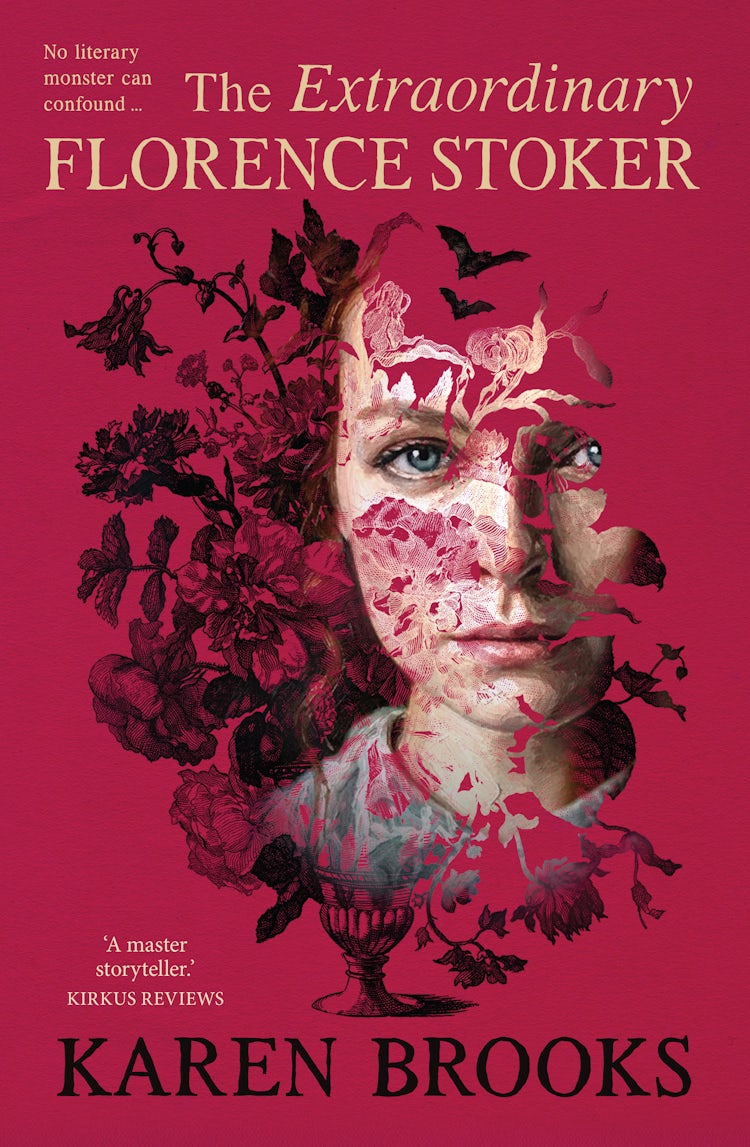
From a bestselling, award-winning author comes a compellingly realised story of an enigmatic figure, the beautiful 19th century muse and brilliant social powerhouse, Florence Stoker, whose life, in spite of her many gifts, was overshadowed by one of the most abiding and terrifying of contemporary culture's monsters, the vampire Dracula - her own husband's creation.
Dublin, 1878. When the witty and beautiful Florence Balcombe marries up-and-coming theatre impresario and putative novelist Bram Stoker, and her dazzling literary salons make her the darling of the literary, theatre and art worlds in London, no-one is surprised. So what if she came from humble beginnings and her prior engagement to Oscar Wilde was inexplicably broken off, she was always exceptional. Besides, none of that matters now she moves in exalted circles and Bram is managing the Lyceum for Henry Irving, the leading actor of his generation.
But appearances can be deceptive. Bram is in thrall to the tyrannical narcissist Henry, who is draining the life from him, and his distance from his marriage bed is noticeable. Dear friend Oscar is in court for gross indecency and Florence is afraid - for her family, of the secret she keeps and of the visions of a monstrous fanged demon that haunts her by day and night.
But Florence will fight for her family and rid herself of the threats - both real and phantom - that plague her, even if it threatens her own sanity.
After all, no ordinary monster can confound the extraordinary Florence Stoker.
2 Comments
I read the introduction pages on Amazon and loved it. I am yet to buy it because my TBR pile is huge but it is on my list. Well done Karen Brooks
What can I say. Picked it up and didn’t put it down till I turned the last page. ❤️