


Kirsty McDermott, author of gothic Australian novel What The Bones Know, dropped by to tell us how she writes spine-tingling horror scenes…
The creak of a floorboard in a dark hallway. Urgent, unintelligible whispers echoing through an empty house. A shape crouching in that shadowed corner of your bedroom as you cower, eyes squeezed shut, beneath the covers. You are alone, you tell yourself, you are alone. The lie sits like spoiled, sour fruit on your tongue.
Crafting a spooky scene that will unsettle readers is a challenge. Even more so, if they are well-versed in the contemporary Gothic and so bring with them high expectations of the genre’s tropes, trappings and themes. Unlike filmmakers, who have at their disposal an arsenal of visual and auditory tools for provoking unease, terror or dread, us literary folk must make do with simple black marks on a page – and, of course, the reader’s own imagination.
Humans are empathetic creatures, especially those of us who read a lot of fiction, and I leverage this quality mercilessly. I develop my characters with great care, fleshing out their foibles, desires and fears, their flaws and strengths, so that readers can engage with them as they might real people. Care about them. Care with them. When that works, the emotions and reactions that a character feels will almost naturally bleed across to the reader themselves. Empathy is a trojan horse, and a perfect mechanism to send that delicious shiver down the back of your neck.
This allows me to focus on how to unnerve my characters specifically, rather than worry too much about whether it might scare readers in general. Our intimate terrors are different after all; one person’s arachnophobia is another person’s adorable eight-legged pet. That said, humans do share an inherent discomfort for the uncanny. That which doesn’t belong, that which isn’t quite as it should be. I play a lot with the uncanny and the weird, sketching in small details for the reader to run with. A bathtub that fills without a tap being turned – and the plug still sitting on the rim. Muddy footsteps leading to where your daughter sleeps – her own feet dry and clean.
Humans also share, if not an outright fear of the dark, then a keen awareness of our vulnerability within it. Our night vision is rubbish, our sense of smell even more so, and we lose our sense of direction too easily. Little wonder that so many spooky scenes are set at night, as are several in my new novel, What the Bones Know. In the darkness, we struggle to see, and very often we don’t even want to look. And while the specifics may differ, we all know what it is to feel scared or helpless or alone. To catch a movement in the corner of our eye or hear a sound we cannot place. To have encountered the inexplicable in some strange fashion.
It’s these visceral, vulnerable memories that I aim to invoke when writing a particularly spooky scene. Take my character’s hand and follow them into the dark.
And please, whatever happens, don’t look away.
ABOUT THE AUTHOR: Kirstyn McDermott
Kirstyn McDermott is an Australian author of two award-winning novels, Madigan Mine and Perfections, along with numerous pieces of short fiction and poetry. Her most recent works are Winterbloom (winner of 2023 Aurealis Award for best fantasy novella), Hard Places, a collection of short fiction, and Never Afters, a novella series of retold fairy tales now collected in an omnibus edition. Kirstyn holds a PhD in creative writing and lives in Ballarat, Australia, with fellow writer Jason Nahrung and two distinctly non-literary felines. www.kirstynmcdermott.com
Don’t miss Kirstyn’s debut novel: What The Bones Know
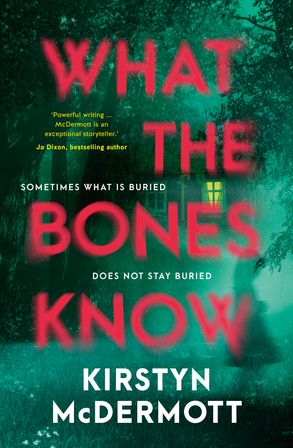
A child’s bones, a lost girl, a mind adrift – sometimes what is lost comes back to haunt you…from an award-winning author comes a contemporary gothic tale of guilt, grief and redemption.
In the village of Kiln Creek in the Victorian Highlands, a ghost gum falls in a storm. Tangled in its roots are the bones of a small child and the tattered remains of her clothing, including a pair of bright-red sneakers.
Single mum Jude Mees is in her early forties and struggling to get her business off the ground while raising her ten-year-old daughter, Katie, and managing a fractious relationship with her controlling ex-husband. But when Jude learns that her mother, Nance, who still lives alone on the family property at Kiln Creek, is showing troubling signs of dementia, she has no option other than to return and check on her.
And indeed, all is not well at the farm. Nance is slowly drifting off into her own world, and there are other disturbing occurrences. Strange smells, inexplicably wet footprints, a voice in the night. As her daughter starts to sleepwalk and Jude’s nightmares take over her days, she begins to wonder whether her imagination is out of control or if something more sinister is happening …
A taut, claustrophobic exploration of what it means to be haunted – by our past, by fractured relationships, by a place we thought we knew and by our own unreliable memories.