


Yumba means ‘camp’ in several Aboriginal languages spoken across southern Queensland and northern New South Wales, including that of the Kooma people – my people. The yumbas were fringe settlements on the outskirts of towns, often near undesirable locations like rubbish dumps, animal pounds and cemeteries. My father grew up on the Charleville yumba in the 1950s. Similar camps could be found around Cunnamulla and Augathella.
When Dad lived there, the Charleville yumba was home to about fifteen Aboriginal families. A cluster of towering white gums marked the entrance, and as you made your way down the road into the camp, thick bushland grew on either side – cypress pines, red berry bushes and monkey trees. The ‘main street’ formed a ring and was affectionately known as ‘the red soil road’ owing to the maroon shades of the sand. Community gatherings and daily life took place along this road, and most homes were built alongside it for easy to the shared amenities block.
The dwellings evolved over time, but during Dad’s childhood, they were like shanty huts made of rusted tin and salvaged wood, and had dirt floors. They had a wood stove, a kerosene lamp, a battery radio and an ice chest for food supplies.
Most families didn’t own cars so they would walk the three kilometres into town for school or work. Conditions were harsh – food was often scarce and they would burn cow dung to keep the mozzies away. Men were frequently away for weeks at a time working on stations, leaving the women to raise children. But there were happy times too.
Dad’s family lived there in relative peace as the big ‘round-ups’ had passed. Most Aboriginal people who survived the frontier wars of the late 1800s and early 1900s were rounded up and sent to reserves, like Cherbourg and Palm Island, in the early to mid-1900s. Early on, whole families were moved, but later, lighter-skinned children were singled out – now commonly referred to as the Stolen Generations. That was my grandfather’s era.
My grandfather, Jack Martin, was targeted by the authorities because of his light skin. His mother hid him when they came searching. Had he been found, he would’ve been sent to a reserve, placed under the Exemption Act, and banned from associating with Aboriginal people outside the reserve. He wouldn’t have been allowed to practice traditional customs or speak his language. His education would have ended at grade four, after which he’d be trained for manual labour – paid less than his non-Indigenous peers, with his wages strictly controlled by the state.
The Stolen Generations era stretched into the 1970s, but Dad doesn’t remember being frightened of being taken when he was a kid on the yumba in the 1950s. People turned a blind eye to their presence because they proved useful as labourers. Life on the yumba was tough – poverty was widespread – but many, like my father’s family, wanted to stay there. Living there meant staying close to traditional lands and avoiding the strict control of government-run missions and reserves.
On the yumbas, there was more freedom. People could come and go as they pleased. They hunted porcupine, caught yellow belly and yabbies, and gathered berries and mussels. They could swim in the Warrego River or play in the swamp behind the camp.
I grew up with a deep awareness of the sacrifices my family made to give me a better life. They left the yumba when my grandad got a job in Cooladdi as a fettler on the railway. Later, during Dad’s teenage years, they moved again – this time to Cambooya, near Toowoomba – to be closer to education and job opportunities.
When I was about eight, Dad took us to visit the site of the old Charleville yumba. He pointed out where they used to eat, sleep and gather around the fire. Only a few fragments remained – rusted tin, worn timber and old tyres – remnants of the shanty dwellings that once stood there. I was moved by how small the space was – the entire home was no bigger than our living room, maybe five by six metres, and that’s where he lived with his parents and siblings.
At the time of visiting, I was too young to fully grasp the hardships Dad had faced, but as I got older, I began to understand what life must have been like – the bug bites, the hunger, the emotional trauma of displacement. Yet despite it all, there’s always been a powerful sense of togetherness and pride that has lasted across the generations. I’ve tried to capture glimpses of that spirit in the 1965 timeline of Melaleuca.
Further reading:
- Herb Wharton: ‘Cattle Camp’ and ‘Yumba Days’
- Hazel McKellar: ‘Woman from No Where’, and ‘Matya-Mundu: A History of Aboriginal People from South West Queensland’
- Garry ‘Sonny’ Martin: ‘The Spoon’ (Indigenous X), ‘Red Soil Road’ (Meanjin) and ‘From Cooladdi to Cambooya’ (The Saltbush Review).
ABOUT THE AUTHOR: Angie Faye Martin
Angie Faye Martin (Kooma/Kamilaroi/European) is a writer/editor currently living on Gubbi Gubbi Country (Redcliffe). She worked in public policy for 15 years before launching a freelance editing business, Versed Writings. She has a Bachelor of Public Health, a Masters of Anthropology, and a passion for fiction.
Melaleuca is her debut novel.
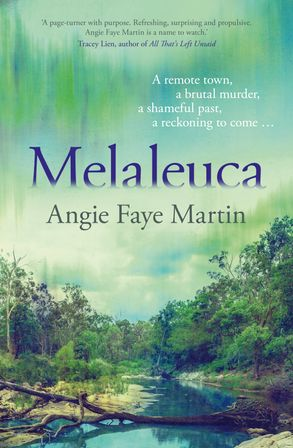
A country town, a brutal murder, a shameful past, a reckoning to come… The injustices of the past and dangers of the present envelop Aboriginal policewoman Renee Taylor, when her unwilling return to the small outback town of her childhood plunges her into the investigation of a brutal murder.
Renee Taylor is planning to stay the minimum amount of time in her remote hometown – only as long as her mum needs her, then she is fleeing back to her real life in Brisbane.
Seconded to the town’s sleepy police station, Renee is pretty sure work will hold nothing more exciting than delivering speeding tickets. Then a murdered woman is found down by the creek on the outskirts of town.
Leading the investigation, Renee uncovers a perplexing connection to the disappearance of two young women thirty years earlier. As she delves deeper and the mystery unfurls, intergenerational cruelties, endemic racism, and deep corruption show themselves, even as dark and bitter truths about the town and its inhabitants’ past rise up and threaten to overwhelm the present…
Authentic, gripping crime drama from a bright new voice in fiction.